
I’m an engineer with decades in the international automotive world —
since 2024 I work as an engineering coach and sparring partner for experienced minds in IT, automotive and industry. The two fields combined are rare. And they’re the reason conversations with me get to the point fast.
What sets me apart from most coaches: I don’t come from HR or consulting, but from labs, international projects and corporate structures. The mix of a technical background and solid coaching training is rare — this makes a difference in the conversation. That mix is exactly what makes me a coach for leaders who speaks the language of the system — not just the language of reflection. An engineering coach.
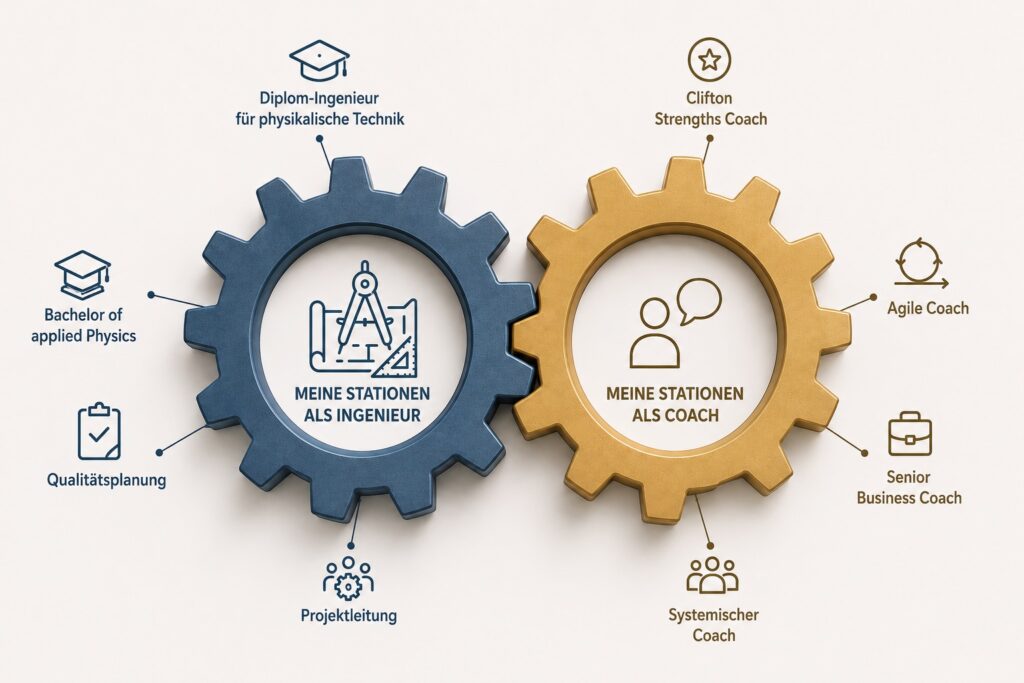
I studied Applied Physics, did research at the Fraunhofer-Institute and then spent around 18 years in the international automotive world. More than seven of those years I carried technical lead responsibility for a quality team of up to five people in international project structures. Over five years I acted as deputy department head, involved in strategic and organisational decision-making.
My work covered budget and results responsibility, steering quality-critical processes, conflict and escalation management — internally and with international customers. I know KPI-driven organisations, matrix structures and the pressure between technical responsibility and organisational demands from my own experience.
Alongside that, I trained as a coach — systemic, agile, strengths-based. Not to leave the engineer behind me, but because the two together create something: analytical thinking and real listening. Structure and depth. Methodical clarity and grounded, real-world judgement.
Since 2024 I’ve worked as an engineering coach for experienced minds in IT, automotive and industry — with everything I learned in both worlds.



“Sort. Prioritise. Move.” — that’s not a marketing slogan.
That’s my own story in three words.
BACKGROUND
There was no moment where I thought: right, now I’ll start getting to know myself better. It was much quieter than that. At some point there was a question that wouldn’t go away: “Who am I, really — beyond my role, my tasks, my performance?”
I started to identify my personal values — and to look honestly at whether I actually live them or just talk about them. That was harder than expected.
Then came the CliftonStrengths report. I got my 34 strengths — but what I really got was a mirror. Clear, concrete, no sugar-coating. That set a things in motion.
The result wasn’t some dramatic change on the outside. But I stopped hiding. I gave feedback and asked for it — even when it was uncomfortable. A colleague put it like this: “You’ve got properly bitchy — it suits you!” That was a compliment.
That’s the reason I do what I do as an engineering coach. Not because I learned a method. But because I know how this process feels.
NEXT STEP
20 minutes — we'll see if it's a fit. That's it.
Briefly outline your situation — I'll follow up with a proposed time.
UNSURE?
Coaching for engineers, by an engineer — and for experienced people in IT, automotive and industry who are looking for someone who shares their way of thinking. Analytical, structured, interested in tangible results. An engineering coach for engineers and leaders.
If you want the person you are speaking to understand what you mean without you having to explain it first, you’re in the right place.
It is less suitable if you are looking for pure self-exploration with no connection to your professional system. In that case, there are approaches that may suit you better.
It means that I understand two levels at the same time: the technical system in which you work, and the human system of roles, expectations and relationships around it.
Analytical thinking and genuine listening in one person. No barrage of methods, but someone who understands the logic of your working world while still keeping an eye on the interpersonal side.
That’s normal. Often, that is precisely the first step: finding out what the issue actually is.
You do not need to arrive with a fully formed question. Sometimes you simply sense that something is not right without being able to name it. We will sort it out together before working on anything. First clarity, then direction.
A good starting point, honestly. Scepticism means you want to know whether something lives up to its promise.
There is no coaching theatre here. As an engineering Coach my coaching is based on diagnosis, structure and practical steps. It is comprehensible and verifiable. If something does not make sense to you, say so and we will look at it together. Not about belief, but about sound reasoning.